
In a full Aula, Dr Tedros reflected on ‘Multilateralism, Health and Peace: Past Achievements, Present Difficulties, Future Hope’. The Lecture is available to watch below.
Highlighting that peace is the best medicine, Dr Tedros underscored that global progress is only possible when countries work together toward common goals — and that every crisis carries opportunities to emerge stronger, more resilient, and more independent.
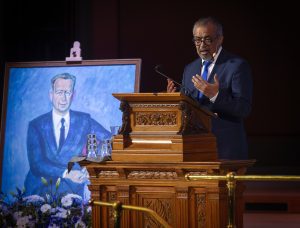
Dr Tedros Adhanom Ghebreyesus
Photo: Mikael Wallerstedt, Uppsala, Sweden.
‘Although many countries are facing a health financing crisis, many leaders from developing countries have told me they see this crisis as an opportunity to leave behind the era of aid dependency and transition to a new era of health sovereignty’, Dr Tedros said.
‘Likewise, although WHO is facing a very difficult situation, I also see it as an opportunity to make it stronger, sharper, more independent, more focused on our core mandate, and more empowered to serve the nations and people of the world.’
Following the Lecture, Dag Hammarskjöld professor Isak Svensson moderated a panel discussion with Farah Aly, Student in Peace and Conflict Research, Uppsala University, Elsa Almersson, Student in Veterinary Medicine at the Swedish University of Agricultural Sciences and Simon-Fredrik Schell, Student in Medicine, Uppsala University. The student panel plays a key role in the lecture program, bringing together a student from the Swedish University of Agricultural Sciences and students from Uppsala University
Finally, Uppsala University presented Dr Tedros with the Dag Hammarskjöld Medal as a recognition of his unwavering commitment to multilateral collaboration, international solidarity, and shared responsibility. Dr Tedros became the 25th honoree to receive the medal.
The complete lecture is available on the WHO website.