
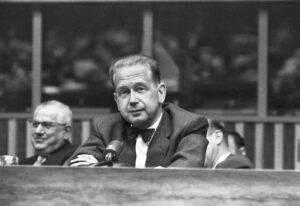
Dag Hammarskjöld was the United Nations second Secretary-General. He served from April 1953 until his untimely death in office. While seeking a solution to the conflict in Congo he died with all 15 others in his company. Their plane crashed in the night of 18 September 1961 when approaching the airport of the Northern Rhodesian mining town Ndola. In a mediation effort, Hammarskjöld was to meet Moïse Tshombe, the leader of the Katanga secession. Initially considered as an accident, new evidence convinced the UN Member States to reopen in 2015 investigations into the cause of the fatal crash. At the end of 2024, this mandate was extended unopposed for the fourth time, with 141 Member States as co-signatories of the Swedish draft resolution.
Who was this man, who died while executing his tasks as the world’s highest international civil servant? Which were his convictions and values? And why are these as relevant now as they were then?
Service to humanity
Hammarskjöld was a cosmopolitan internationalist made in Sweden. This is no contradiction. He was conscious of and never abandoned his Swedish identity. But he applied it globally in the service of humanity. Rooted in local culture and social norms gave him the security of engaging open mindedly with (real or perceived) so-called otherness. A firm value system and moral principles were the point of departure for his encounter with the varieties of cultures and beliefs – explorations guided by the trust in and pursuance of a better world. He personified the virtues of a Swedish civil servant tasked to work for the well-being of people in the public interest. When entering office as Secretary-General he declared:
“I inherited a belief that no life was more satisfactory than one of selfless service to your country – or humanity. This service required likewise the courage to stand up unflinchingly for your convictions.”
During the 80th Anniversary of the UN General Assembly’s first meeting, Secretary-General António Guterres addressed the United Nations Association of the United Kingdom on 17 January 2026. He characterised the United Nations as a place, in which people put their faith for peace, for security, and for a better life.
Dag Hammarskjöld personified and lived such faith. The Charter was his bible for global governance. He was at times referred to as a “secular Pope”. The former British Foreign Secretary Douglas Hurd remembered that Hammarskjöld was attributed a “pontifical manner”, suggesting that he
“was working himself into the position of a Pope … gradually assuming not precisely infallibility, but an assumption in his own mind that he had a mission … to uphold the role and importance and integrity of the United Nations and the Secretary General was the high priest.”
Dag Hammarskjöld’s spiritual and ethical compass, documented in his notebook posthumously published as Markings, was also a beacon for mundane policy, Realpolitik, and diplomacy. His loyalty to universal principles for all guided his role in decolonisation. He was the advocate of those Member States, who had no voice and no seat at the table of the powerful. His anti-hegemonic stand made him their Secretary-General.
Equality in diversity
In an address in 1956, Hammarskjöld spoke of the ecumenical “Uppsala Tradition”. In his characterization of its disciples, he refers to an approach and mindset beyond boundaries:
“At their best the representatives of this legacy show the quiet self-assurance of people firmly rooted in their own world, but they are, at the same time and for that very reason, able to accept and develop a true world citizenship. … They know that their only hope is that justice will prevail and for that reason they like to speak for justice. However, they also know the dangers and temptations of somebody speaking for justice without humility. They have learned that they can stand strong only if faithful to their own ideals, and they have shown the courage to follow the guidance of those ideals to ends which sometimes, temporarily, have been very bitter. And finally, the spirit is one of peace…”
For Hammarskjöld the “Uppsala Tradition” was one of global, also secular, human commitment. He believed in the need to engage in the political sphere and economic relations within and between countries to address matters of social justice. Serving as Secretary-General when decolonization of African countries gained momentum, he advocated equality both locally and internationally.
Addressing the students at the University of Lund in southern Sweden in 1959 on “Asia, Africa and the West”, Hammarskjöld stated:
“The health and strength of a community depend on every citizen’s feeling of solidarity with the other citizens, and on his willingness, in the name of this solidarity, to shoulder his part of the burdens and responsibilities of the community. The same is of course true of humanity as a whole. And just that it cannot be argued that within a community an economic upper class holds its favored position by virtue of greater ability, as a quality which is, as it were, vested in the group by nature, so it is, of course, impossible to maintain this in regard to nations in their mutual relationships. […]
We thus live in a world where, no more internationally than nationally, any distinct group can claim superiority in mental gifts and potentialities of development. (…) Those democratic ideals which demand equal opportunities for all should be applied also to peoples and races. (…) no nation or group of nations can base its future on a claim of supremacy.”
Global governance: norms and principles
His emphasis on equality of Member States and the faith in and loyalty to the principles defined by the Charter formed an anti-hegemonic execution of office. The Introduction to the 16th Annual Report of the United Nations in August 1961 reiterated his firm belief in equality. As he declared:
“In the Preamble to the Charter, Member nations have reaffirmed their faith ‘in the equal rights of men and women and of nations large and small,’ a principle which also has found many other expressions in the Charter. Thus it states the basic democratic principle of equal political rights, independently of the political position of the individual or of the Member country in respect of its strength, as determined by territory, population or wealth.”
Hammarskjöld was aware of the limits of the global, value-based institutions confronted with selfish interests in violation of the fundamental principles in the Charter. He had no illusions: speaking truth to power was for him an integral part of international civil service. This was guided by the conviction that the executed tasks must be loyal to a concept of neutrality, while taking a stand in the spirit of the Charter. In a debate during the Suez crisis in October 1956, he stated in the Security Council:
“The principles of the Charter are, by far, greater than the Organization in which they are embodied, and the aims they are to safeguard are holier than the policies of any single nation or people.”
He further confessed in his Introduction to the Annual Report for 1959-1960:
“It is my firm conviction that any result bought at the price of a compromise with the principles and ideals of the Organization, either by yielding to force, by disregard of justice, by neglect of common interests or by contempt for human rights, is bought at too high a price.”
Far from idolising the institution he personified as the highest office bearer, he insisted that there no better alternative exists. In an address at the University of California in May 1954, he paraphrased a statement by the then US-American Ambassador to the UN, Henry Cabot Lodge Jr:
“It has been said that the United Nations was not created in order to bring us to heaven, but in order to save us from hell. I think that sums up as well as anything that I have heard both the essential role of the United Nations and the attitude of mind that we should bring to its support.”
Integrity matters
In his remarks at the UN Association of the UK on 17 January 2026, Secretary-General Guterres paid tribute to Sir Brian Urquhart as the longest serving international civil servant. Sir Brian had joined the UN as one of the first staff members in 1945 and worked closely with five Secretary-Generals. As Urquhart observed in retrospect:
“Integrity was a quality to which Hammarskjöld attached the highest importance, and it was the keynote of his approach to political and diplomatic action. He would not, indeed could not, undertake an action he thought dishonest or unworthy.”
And Sture Linnér, who was close to Dag Hammarskjöld, characterised him as follows:
“Hammarskjöld’s ethical capacity was both his strength and his weakness. Integrity, honesty and character were the basis for all his work. But at the same time he could not understand some procedures of power politics. He could not understand and would not believe that people should be dishonest on very sincere matters and he got indignant about lying.”
Already in 1950 Dag Hammarskjöld had entered in his notebook:
“Hunger is my native place in the land of the passions. Hunger for fellowship, hunger for righteousness – for a fellowship founded on righteousness, and a righteousness attained in fellowship.”
If only there would be more people in office these days, who would share such hunger.
Hammarskjöld’s legacy
Hammarskjöld’s engagement with global affairs in his advocacy of the United Nations mandate testify to his firm conviction that international relations in the post-WW2 era had to rely on the building of a strong institution, facilitating global governance on common grounds. Founded by 51 Member States in 1945, its number has since then increased to 193. The adoption of its Charter in the founding year was followed by the Convention on the Prevention and Punishment of the Crime of Genocide and the Universal Declaration of Human Rights in December 1948. Since then, numerous normative frameworks followed. They all provide guidance and clarity in international law. “Do we need the United Nations?” was the questioning title of Hammarskjöld’s address before the Students’ Association in Copenhagen in May 1959. His answer could still be given today:
“We need it for the constructive addition it offers in international attempts to resolve conflicts of interests. And we need it as a foundation of and a framework for arduous and time-consuming attempts to find norms in which an extranational – or perhaps even supranational – influence may be brought to bear in the prevention of future conflicts.”
Despite all limitations, setbacks and failures, the UN system has remained the body, in which the global community of states can exchange views in search of a common ground, if only at times to confirm dividing lines and dissensus. For Hammarskjöld, the UN was based on the commonality of humankind and supposed to act as facilitator and mediator. To execute such tasks, he saw the need for a strong mandate despite – or rather because – of the deep rifts between Member States. A mandate having the necessary degree of autonomy from big powers and their agenda-setting interests. Before leaving to the Congo in September 1961, he addressed the staff in New York for the last time. His words ring true as much if not even more today:
“It is true that we are passing through a period of unusual threats to human society and to peace. … It is also true that the Organization is necessarily a modest one, subordinated as it must be to governments, and through governments to the will of the people.
But, although the dangers may be great and although our role may be modest, we can feel that the work of the Organization is the means through which we all, jointly, can work so as to reduce the dangers. It would be too dramatic to talk about our task as one of waging a war for peace, but it is quite realistic to look at it as an essential and – within its limits – effective work for building dams against the floods of disintegration and violence.”