As Under-Secretary-General for Safety and Security, Gilles Michaud leads the United Nations Department for Safety and Security (UNDSS), the entity which enables the safe and effective delivery of United Nations programmes and operations worldwide. The department leads security across the entire UN system, enabling the safe delivery of humanitarian aid and UN programmes in some of the world’s most volatile and dangerous environments. What does norm-based leadership look like in settings where political, operational, and security pressures intersect and place competing demands on leaders?
For Michaud, principled leadership is anchored in deeply internalised values shaped long before his time at the UN: respect, accountability, humility, and the primacy of the greater good. In difficult situations, these values have served as a practical barometer for his decision-making. He often asks himself a simple question: “What would my parents say?” This, he explains, helps him remain grounded and “cool-headed” in volatile environments where norms are increasingly under strain.
Another guiding principle is maintaining clarity about who UN leaders are ultimately accountable to. “We, the department of security professionals, are accountable to the people that we need to protect,” he says. “But the real accountability lies with the beneficiaries, those who are to receive the services of the UN. That means we must be willing to take some risks to reach the people who really need our aid – for whom it’s life or death.”
Risk, trust and accountability to those we serve
Here he highlights a central tension between risk avoidance and accountability to those the UN exists to serve. “Technically I could keep all UN staff safe by telling them: you’re not going anywhere, you’re staying in your offices or guest houses. None of the staff will lose their lives. But if we do that, there will be millions of people who suffer and do not get the aid they need.” Norm-based leadership, Michaud argues, therefore requires calibrated risk-taking, guided by international law and humanitarian principles such as humanity, impartiality, neutrality, and independence.
In this context, trust is essential. “People in security will often accept risks if they know they can trust that someone will support them when they take action, as long as they can show that they are making the best call with the information they have” he explains. “If something goes wrong, my people know that I will back them up. And that trust creates the willingness to take the risks we often need to take, so that beneficiaries receive the services they need.”
Credibility, he adds, is earned not through rhetoric but through behaviour, especially in moments of crisis. “The level of people’s confidence in you depends on how you behave, particularly in highly stressful situations. How you communicate in a crisis is key, and so is showing up, leading from the front on those occasions”.
When asked how to navigate potential tensions between operational realities and normative commitments, Michaud emphasises that there is little room for trade-offs. Deviating from norms and principles risks a slippery slope that could weaken the UN’s moral authority. Yet operational realities sometimes collide with personal convictions. In such moments, leaders may have to make difficult compromises in pursuit of the greater good.
He recalls travelling to Kabul shortly after the Taliban returned to power in Afghanistan in 2021, where he met with a controversial Taliban representative to negotiate the conditions under which UN humanitarian operations could continue. “The neutrality of humanitarian law means we have to deal with all parties to a conflict,” he says. “That means sitting across the table from people I would have arrested in my previous life in law enforcement. But if we don’t engage with them respectfully to negotiate secure access, then we’re not going to reach the people who need our help.”
Reform, resources, and leadership dilemmas
Organisational transformation and reform bring another set of leadership dilemmas. Michaud points to the UN80 Initiative, which aims to make the organisation more agile, efficient, and fit for purpose. “UN80 is forcing us to think differently. It’s forcing us to innovate and maximise the capabilities we have. The organisation needs to transform itself, but it’s painful.”
Michaud notes that the space within which UN leaders operate is increasingly shaped by the funding decisions of Member States. “Ultimately, they are the owners of the organisation,” he says. “They decide what mandates we receive and with what resources we have to implement them.” Earmarked funding and dramatically reduced budgets inevitably influence how far and how effectively the UN can reach those it serves. While such constraints affect operational capacity—for example limiting the flexibility to respond rapidly to crises—they do not, he stresses, change the organisation’s normative foundations. The challenge for UN leaders is therefore to adapt: to find new ways of working, innovate, and maximise existing capabilities while remaining firmly anchored in the principles that guide the organisation.
Reforms sometimes require leaders to implement decisions they may not fully agree with, such as implementing sweeping cuts. In such situations, Michaud believes the responsibility of leadership is to look beyond initial reservations and try to identify opportunities for improvement. “Being a bit more innovative, taking a bit more risks in the way we operate, using crisis to accelerate transformation that was already under way – taking advantage of the pressures that we are facing. In times of reform, the challenge is balancing the needs of the organisation with those of our personnel. I want to do right by my people, but I also have a responsibility to the organisation.”
In February 2025, Michaud was tasked with cutting the 2026 UNDSS field budget by 20 percent. The dilemma was not only financial, but also human. “To do this perfectly would have required six months of consultations, but staff would have had little time to plan their careers and families,” he says. Instead, he chose to act more quickly: “I had to choose between being 100 percent right too late, or about 80 percent right now. We developed the best model we could within three months so staff would have time to plan.”
For Michaud, leadership ultimately comes back to purpose. “For me, there are millions of people out there who need us,” he reflects. “They deserve our best. That’s what keeps me going in difficult times. There is a continuous hope for a better world—and somebody has to do the work. Might as well be me.”
About Gilles Michaud
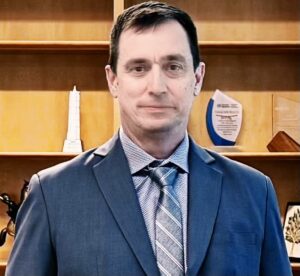 Gilles Michaud is the United Nations Under-Secretary-General for Safety and Security, where he leads the organisation’s efforts to enable aid delivery in over 130 countries. A former Deputy Commissioner of the Royal Canadian Mounted Police with over three decades in policing, he has been at the forefront of UN security operations since July 2019.
Interview and text by Annelies Hickendorff.